As Amazon continues to grow more competitive, sellers are constantly looking for ways to streamline operations, reduce costs, and scale efficiently. One of the most critical decisions an Amazon seller must make is how to handle order preparation and fulfillment. The debate around Prep Center vs In-House Fulfillment for Amazon Sellers has become increasingly relevant, especially for private label and wholesale sellers aiming for long-term growth.
Understanding the pros and cons of each approach can help you choose the best model for your business.
Understanding In-House Fulfillment
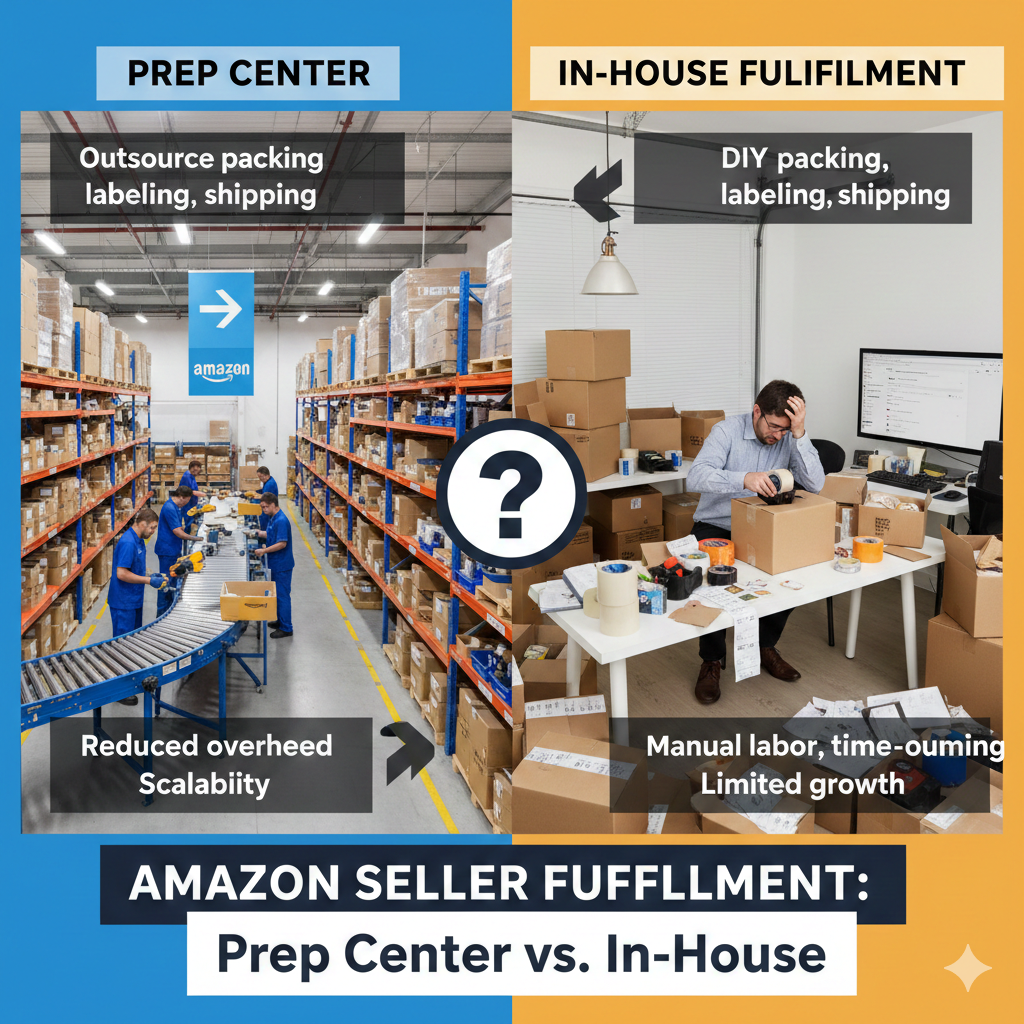
In-house fulfillment means that you handle every aspect of the fulfillment process yourself. This includes receiving inventory, inspecting products, labeling, packing, and shipping items to Amazon FBA warehouses or directly to customers.
For new or small-scale sellers, this method often feels like the most straightforward option. You have full control over quality checks, packaging standards, and timelines. Additionally, startup costs may appear lower since you don’t have to pay a third party for services.
However, as order volume increases, in-house fulfillment can quickly become overwhelming. You may need more storage space, labor, packaging supplies, and time. This is where the comparison of Prep Center vs In-House Fulfillment for Amazon Sellers becomes crucial, especially when scaling challenges arise.
What Is an Amazon Prep Center?
An Amazon prep center is a third-party service that handles product preparation according to Amazon’s strict FBA requirements. These centers receive your inventory, inspect it, label it, bundle products if needed, and ship it directly to Amazon fulfillment centers.
Prep centers are especially popular among wholesale sellers, online arbitrage sellers, and international Amazon sellers who cannot physically manage inventory themselves. When analyzing Prep Center vs In-House Fulfillment for Amazon Sellers, prep centers often stand out for their efficiency and scalability.
Cost Comparison
At first glance, in-house fulfillment may seem cheaper because you’re not paying service fees. However, hidden costs such as rent, utilities, employee wages, packaging materials, and time spent managing logistics can add up quickly.
Prep centers charge per unit or per service, making costs more predictable. While the per-item cost may be higher, you save on infrastructure and labor. In the long run, many sellers find that Prep Center vs In-House Fulfillment for Amazon Sellers is less about upfront cost and more about operational efficiency and time savings.
Scalability and Growth
Scalability is one of the biggest deciding factors. In-house fulfillment limits how fast you can grow unless you significantly invest in space and manpower. Seasonal spikes, such as Q4 sales, can strain your operations and lead to delays or errors.
Prep centers are built to handle volume. They already have systems, staff, and space to manage sudden increases in inventory. When comparing Prep Center vs In-House Fulfillment for Amazon Sellers, prep centers clearly offer an advantage for sellers planning rapid growth.
Time Management and Focus
Time is one of the most valuable resources for an Amazon seller. Managing fulfillment in-house can consume hours that could otherwise be spent on product research, marketing, supplier negotiations, and account optimization.
Using a prep center allows you to focus on revenue-generating activities rather than operational tasks. This shift in focus is a major reason why many experienced sellers favor prep centers when evaluating Prep Center vs In-House Fulfillment for Amazon Sellers.
Control and Quality Assurance
In-house fulfillment gives you direct oversight of your products, which can reduce errors if managed properly. However, reputable prep centers follow Amazon’s guidelines strictly and often have quality control systems in place to minimize mistakes.
The key is choosing a reliable prep center with transparent processes and good reviews. In the debate of Prep Center vs In-House Fulfillment for Amazon Sellers, quality ultimately depends on execution rather than the model itself.
Final Verdict
There is no one-size-fits-all answer. Small sellers with low order volumes may benefit from in-house fulfillment initially. However, sellers aiming to scale efficiently, save time, and reduce operational stress often find prep centers to be the better long-term solution.
When deciding between Prep Center vs In-House Fulfillment for Amazon Sellers, consider your current volume, growth goals, available time, and budget. Making the right choice can significantly impact your profitability and business sustainability.